




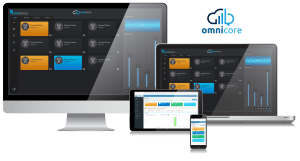
Radio Standard

Project 25

Developed by the Association of Public Safety Communications Officials International (APCO), P25 is a radio standard that is the preferred choice for many public safety organizations for ensuring inter-agency cooperation.
Omnitronics has worked directly with a number of P25 radio manufacturers including Eclipse, ICOM, Kenwood, Simoco and Tait to develop a P25 interface that ensures interoperability and provides users with optimal network choice.

Whilst P25 systems may not be the best fit for all organizations, there are many benefits of utilizing this standard – the main one being improved interoperability. Since P25 is an open standard, multiple protocols (both analog and digital) and manufacturers can be used on the same network. This is a major benefit especially for those organizations within the public safety sector, as different agencies and neighbouring jurisdictions can communicate with each other even if they have purchased their equipment from different manufacturers. This level of interoperability lead to some of the other benefits of P25 CSSI, such as flexibility and cost-effectiveness, as organizations now have more options to select the best equipment for their operation. Any manufacturer that provides a CSSI interface to P25 standards can connect to Omnitronics Dispatch, further reinforcing the benefits of enhanced interoperability and flexibility within the P25 standard. Our dispatch powerhouse, omnicore has a choice of networking options as well that further adds compatibility.

P25 is not only cost efficient because of its flexibility, but also has enhanced spectrum efficiency. Phase 2 of P25 provides two effective channels per 12.5khz bandwidth, and is backwards compatible with Phase 1 radios. This allows phase 2 radio users to operate on a phase 1 network. Some implementation costs can be reduced with utilizing P25 as well. Not only can the flexibility of P25 assist businesses to stay on budget, however some implementation costs can be reduced when utilising a P25 system, such as vocoders not needing to be located at each dispatch operator position, rather at the gateway itself.

Omnitronics is an active member and contributor to the PTIG P25 Technology Interest Group.

omniGateP25

P25 CSSI Gateway

omniGateP25 is a Linux-based radio dispatch console interface that provides a trunked CSSI implementation allowing up to 128 talk paths and 48 simultaneous conversations over one CSSI connection. omniGateP25 is phase 1/phase 2 compatible.

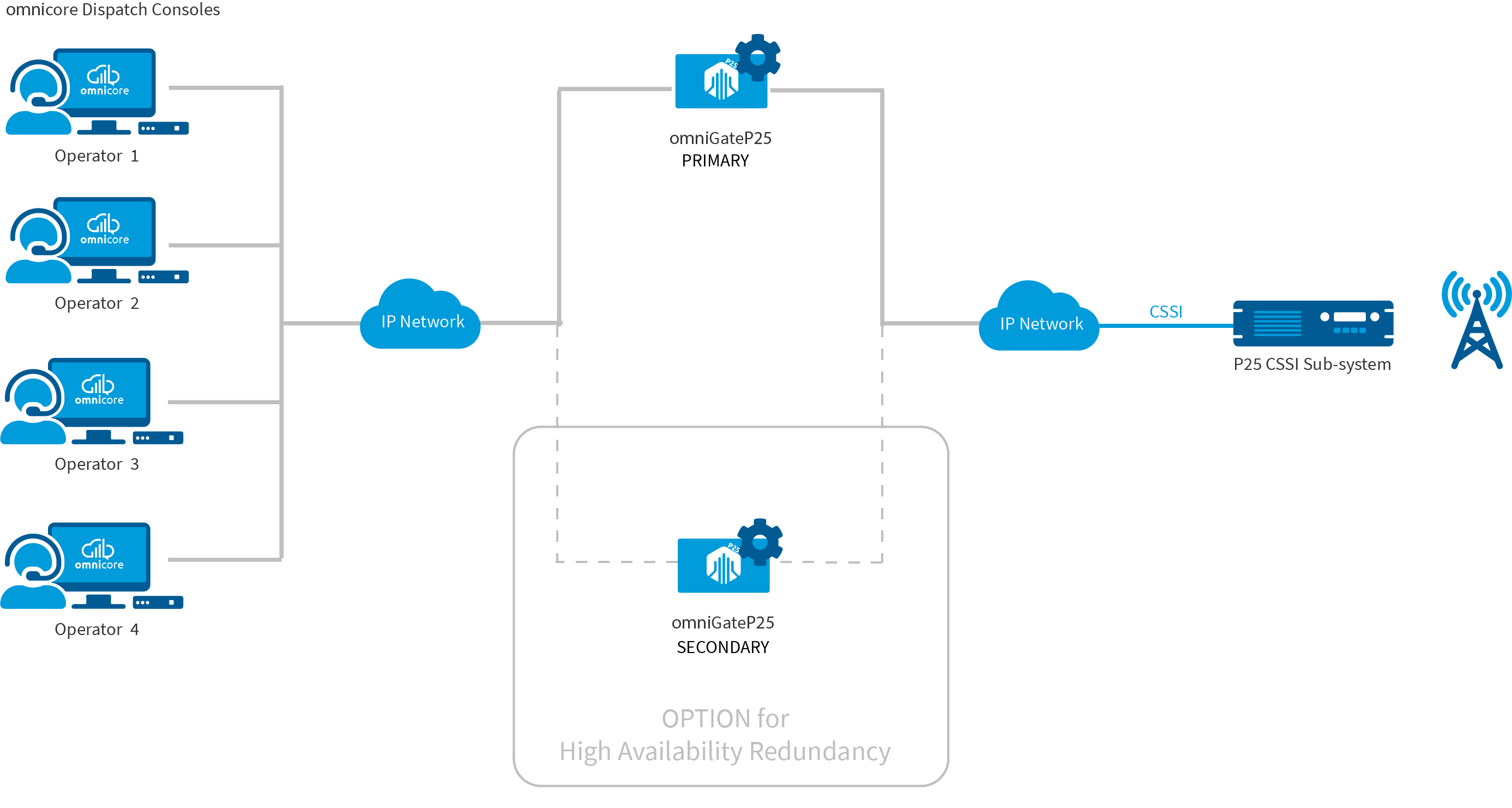
Network Diagram

omniGateP25 CSSI Radio Over IP Gateway

Connecting multiple dispatch console using a single CSSI connection.
EXPLAINER

Benefits of P25 CSSI

P25 CSSI  provides a unique level of flexibility when selecting the best console system solution. The open-architecture standard allows for interconnection of multiple types of consoles, audio systems, and other equipment from various manufacturers into one integrated communications architecture.

White Paper

Which Dispatch Solution?

With the large variety of dispatch consoles and solutions out there, not to mention the differing protocols and technologies, choosing the best dispatch console for your organization can be a confusing process.

Project 25 Technology Interest Group (PTIG)

Project 25 Frequently Asked Questions (FAQ)

Version 1.9 250603 | Copyright: Project 25 Technology Interest Group 

O
P

Where can I view the latest list of P25 Standards Documents available?

The PTIG Home Page www.project25.org has a direct link to the current list of P25 Steering Committee approved P25 Standards documents The link can be accessed by clicking on the Blue Box on the PTIG home page for “P25 SC Approved list of Standards”.

O
P

What is Project 25 (P25)?

Project 25 (P25) is a suite of over 80 standards documents for the design and manufacture of interoperable digital Land Mobile Radio (LMR) wireless communications products. The Standards have been developed with state, local and federal government representatives, manufacturers and service providers all under Telecommunications Industry Association (TIA) governance.

P25 has gained worldwide acceptance for government, public safety, public service, military, transportation, utilities, and critical Infrastructure applications.

The published P25 standards suite is administered by the Telecommunications Industry Association (TIA Mobile and Personal Private Radio Standards Committee TR-8). Radio equipment that demonstrates compliance with P25 is able to meet requirements that fit the needs of public safety and government users.

Project 25 manufacturers take the features and specifications defined by the P25 Standards and implement them in reliable software, hosted on rugged hardware platforms that are exhaustively tested to ensure systems are reliant and resilient and that the Project 25 features and capabilities are available even under severe conditions.

O
P

Where can I get a copy of P25 Standards documents?

Copies of the Standards are free to Government Agencies in the United States. Follow this link for an application form
https://tiaonline.org/wp-ontent/uploads/2020/11/20240730-P25-Request-Form.pdf

For government agencies outside of the United States, please contact Victoria Mitchell at TIA using the link below: [email protected]
Documents for Commercial Entities can be ordered at: https://store.accuristech.com/tia

O
P

Where can I view the latest Changes and Updates to the P25 Standards and future work in progress?

The www.project25.org homepage has a direct link to a report on the latest P25 Standards update from the most recent TIA TR-8 meetings. The report can be downloaded using the blue box link on the PTIG home page for “Project 25 Standards Latest Update”. The site also has a link to the current list of P25 Steering Committee approved P25 Standards documents under the documents tab.

O
P

How do I find which operational requirements and features are covered in the P25 Suite of Standards?

TSB-102 document is an overview of the P25 suite of standards. That is the place to start and will provide guidance on P25/TIA-102 documents on specific interfaces and services.
Copies of the Standards are free to Government Agencies in the United States. Follow this link for an application form https://tiaonline.org/wp-content/uploads/2020/11/20240730-P25-Request-Form.pdf

For government agencies outside of the United States, please contact Victoria Mitchell at TIA using the link below: [email protected]

Documents for Commercial Entities can be ordered at: https://store.accuristech.com/tia

O
P

Are supplementary services in the P25 Standard available with multi-vendor offerings?

Yes. The TIA TSB-102 document is an overview of the P25 suite of standards. That is the place to start and will provide guidance on P25/TIA-102 documents on specific interfaces and services.
Consult vendors for their specific offerings.

O
P

What is the Project 25 Statement of User Needs (SPUN)?

The Statement of Project 25 (P25) User Needs (SPUN) is derived from the original P25 Statement of Requirements (SoR) document and describes user needs and P25 functionality from the perspective of P25 users. This new SPUN document provides high-level explanations of P25 system architecture, features, and functions as defined in the Telecommunications Industry Association (TIA) 102 Suite of Standards (P25 Standards) and as communicated by P25 public safety users and system administrators.
The SPUN was developed by the Project 25 Steering Committee with support from the Cybersecurity and Infrastructure Security Agency (CISA). The document is currently managed by the P25 Public Safety User Needs Working Group (PSUNWG).
The full document can be downloaded using the link below: https://www.project25.org/images/stories/ptig/Revised_Statement_of_P25_User_Needs_508_Approved_March_2024_1.pdf

This document offers a description of the P25 system model and the organization of P25 Standards documents to give users a baseline of current P25 capabilities and features. The SPUN also provides a framework for users to review, identity, and effectively communicate their needs to those involved in the standards-development process.
That said, not all services, features, and capabilities listed in the user needs tables are addressed by current P25 Standards and/or available on the market. In practice, most P25 systems do not include all the services, features, and capabilities described in the SPUN. This document is intended as a resource for understanding P25 Standards and user needs related to those standards. The lists of user needs should not be considered a complete or binding list of P25 requirements for procurement decisions. Finally, as technologies advance, new user needs likely will emerge and existing needs will be modified or removed.

O
P

How are P25 Standards documents created?

The P25 Suite of Standards is a library of over 80 documents and standards adopted by the P25 Steering Committee. The TIA-102 series of standards makes up the bulk of the P25 Standard. To date, all documents included in the suite of P25 Standard Documents are created and maintained by the TIA TR-8 Engineering Committee.
Creating a new P25 Standard document typically results from a sequential, but iterative, process between TIA TR-8 and P25 users as described below:
• The NCSWIC/SAFECOM P25 Public Safety User Needs Working Group (PSUNWG) identifies a need for a standard to enable interoperability of some “feature.” This may also be added to the Statement of Project 25 User Needs (SPUN);
• APIC Task Group (combination of manufacturers and NCSWIC/SAFECOM P25 Public Safety User Needs Working Group (PSUNWG) users develops a draft Standard;
• The associated TIA TR-8 Subcommittee including manufacturers and users from NCSWIC/SAFECOM P25 Public Safety User Needs Working Group (PSUNWG) prepare an official TIA-102 standard for publication based on the APIC draft;
• Project 25 Steering Committee adopts the TIA Standard as part of the suite of P25 Standards;
• TIA publishes and maintains the TIA-102 standard.

O
P

What is the difference between P25 Phase 1 and P25 Phase 2?

P25 Phase 1 should be referred to as FDMA (frequency division multiple access) and is available in both conventional and trunked systems while P25 Phase 2 should be referred to as TDMA (time division multiple access), and is only available in P25 trunked systems. P25 Phase 1 may also be known as “full rate” while Phase 2 may be known as “half rate.”
P25 Phase 1 allows for one voice or data transmission per RF channel at one time. P25 Phase 2 allows for two voice or data transmissions per RF channel.
P25 Phase 1 supports a single control channel per RF channel. P25 Phase 2 allows for one control channel that utilizes both TDMA time slots or a control channel and a voice or data transmission per RF channel.

TDMA trunked Data operation or Conventional Voice/Data channel are potential future work items dependent on user input/prioritization.
Project 25 Users should always inquire with P25 system/subscriber manufacturers for availability of any feature/function.

O
P

When will the P25 Standard be complete?

The P25 Standards are continually updated to address the evolving needs of users, and changing FCC, NTIA, and Global Regulatory requirements. The P25 Standard will continue to evolve with new specifications and clarifications that will resolve interoperability issues, add additional features, offer improved performance, add security upgrades, offer new testing specs, and create additional interfaces.

O
P

Where can I find a list of the known Project 25 Systems on the air Today?

PTIG members have identified over 3368 (2387 Conventional and 981 Trunked) P25 Systems that are operating world-wide on the air today, and more are in the planning stage The PTIG Home Page https://www.project25.org/ has a direct link to a current list of P25 Trunking Systems and a second list of P25 Conventional Systems. The links can be accessed by clicking on the Blue Boxes on the PTIG home page for “List of P25 Trunking Systems” and “List of P25 Conventional Systems”.

Too Much Choice?

So much choice can be confusing and that’s where Omnitronics can help. We have worked directly with many of the above Radio Manufacturers to create the Digital Radio Gateways that can interconnect them into one common network.
By using this approach, a number of benefits are achieved by P25 users:

  • Cost Savings  due to the P25 vocoder being centrally located at the gateway not at each dispatch operator position.
  • Multiple protocols (both analog and digital) and manufacturers can be used on the same network.
  • Radios can be accessed simultaneously by a Mixture of Dispatch Consoles.
  • The cost and complexity of the Dispatch GUI is reduced by loading time critical and proprietary functions to the Gateway.
  • Organizations have the flexibility to Change Protocols or Radio Manufacturers.
  • 3rd Party Integrators such as IP Voice Recorders can interface to the Omnitronics network, not all the differing interfaces.
  • Choice of networking options to ensure network flexibility and resilience.

Omnitronics has developed a range of interfaces for differing P25 manufacturers, including both proprietary and P25 standard features.

SOLUTION

Connecting Analog Equipment to P25 Talkpaths

Connecting analog equipment like phones, consoles or radios to P25 talkgroups has never been easier with the range of Omnitronics RoIP and Interoperability Gateways. 

On-Demand Video

Benefits of P25 CSSI

Find out how P25 CSSI can be used to interconnect separate radio technologies, how to save $$ with the right gateway, and what features are available in dispatch consoles.

Why Choose Omnitronics for your P25 Dispatch

  • We have variety of Dispatch Solutions for you to choose from:
    • omnicore Express Dispatch  Console | Simple to use touch-screen console for small to medium organizations. No server required.
    • omnicore Essentials Radio Dispatch Software | A complete Digital Radio Management System that includes all the functions of Express but with added features, more channels and more operator licenses to suit medium to large organizations.
    • omnicore Enterprise Dispatch | The Quantum Leap in Scalable Enterprise Dispatch can be hosted on site, in the cloud or data center and is the Dispatch solution for large organizations. 
  • Our consoles include a large range of useful features such as Call Recording, SIP  Telephony and Emergency Management.
  • Integration with Advanced Location Services.
  • High Customizability to support simple or advanced screen configurations, relative to your needs.
  • We work with you on system design to ensure your needs are met including customizations if required.
  • Ongoing Support Options including upgrades to with the latest features.
We'll find the perfect system for your individual needs
P25 FAQ

P25 FAQ

Project 25 Technology Interest Group (PTIG) Project 25 Frequently Asked Questions (FAQ) Version 1.9 250603 | Copyright: Project 25...
read more
Contact Us

Contact Us

Get in Touch