






Radio Standard
Project 25
Developed by the Association of Public Safety Communications Officials International (APCO), P25 is a radio standard that is the preferred choice for many public safety organizations for ensuring inter-agency cooperation.
Omnitronics has worked directly with a number of P25 radio manufacturers including Eclipse, ICOM, Kenwood, Simoco and Tait to develop a P25 interface that ensures interoperability and provides users with optimal network choice.
Whilst P25 systems may not be the best fit for all organizations, there are many benefits of utilizing this standard – the main one being improved interoperability. Since P25 is an open standard, multiple protocols (both analog and digital) and manufacturers can be used on the same network. This is a major benefit especially for those organizations within the public safety sector, as different agencies and neighbouring jurisdictions can communicate with each other even if they have purchased their equipment from different manufacturers. This level of interoperability lead to some of the other benefits of P25 CSSI, such as flexibility and cost-effectiveness, as organizations now have more options to select the best equipment for their operation. Any manufacturer that provides a CSSI interface to P25 standards can connect to Omnitronics Dispatch, further reinforcing the benefits of enhanced interoperability and flexibility within the P25 standard. Our dispatch powerhouse, omnicore has a choice of networking options as well that further adds compatibility.
P25 is not only cost efficient because of its flexibility, but also has enhanced spectrum efficiency. Phase 2 of P25 provides two effective channels per 12.5khz bandwidth, and is backwards compatible with Phase 1 radios. This allows phase 2 radio users to operate on a phase 1 network. Some implementation costs can be reduced with utilizing P25 as well. Not only can the flexibility of P25 assist businesses to stay on budget, however some implementation costs can be reduced when utilising a P25 system, such as vocoders not needing to be located at each dispatch operator position, rather at the gateway itself.
Omnitronics is an active member and contributor to the PTIG P25 Technology Interest Group.
omniGateP25
P25 CSSI Gateway
omniGateP25 is a Linux-based radio dispatch console interface that provides a trunked CSSI implementation allowing up to 128 talk paths and 48 simultaneous conversations over one CSSI connection. omniGateP25 is phase 1/phase 2 compatible.

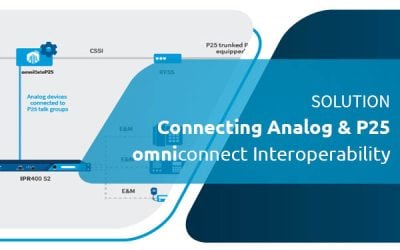
Network Diagram
omniGateP25 CSSI Radio Over IP Gateway
Connecting multiple dispatch console using a single CSSI connection.
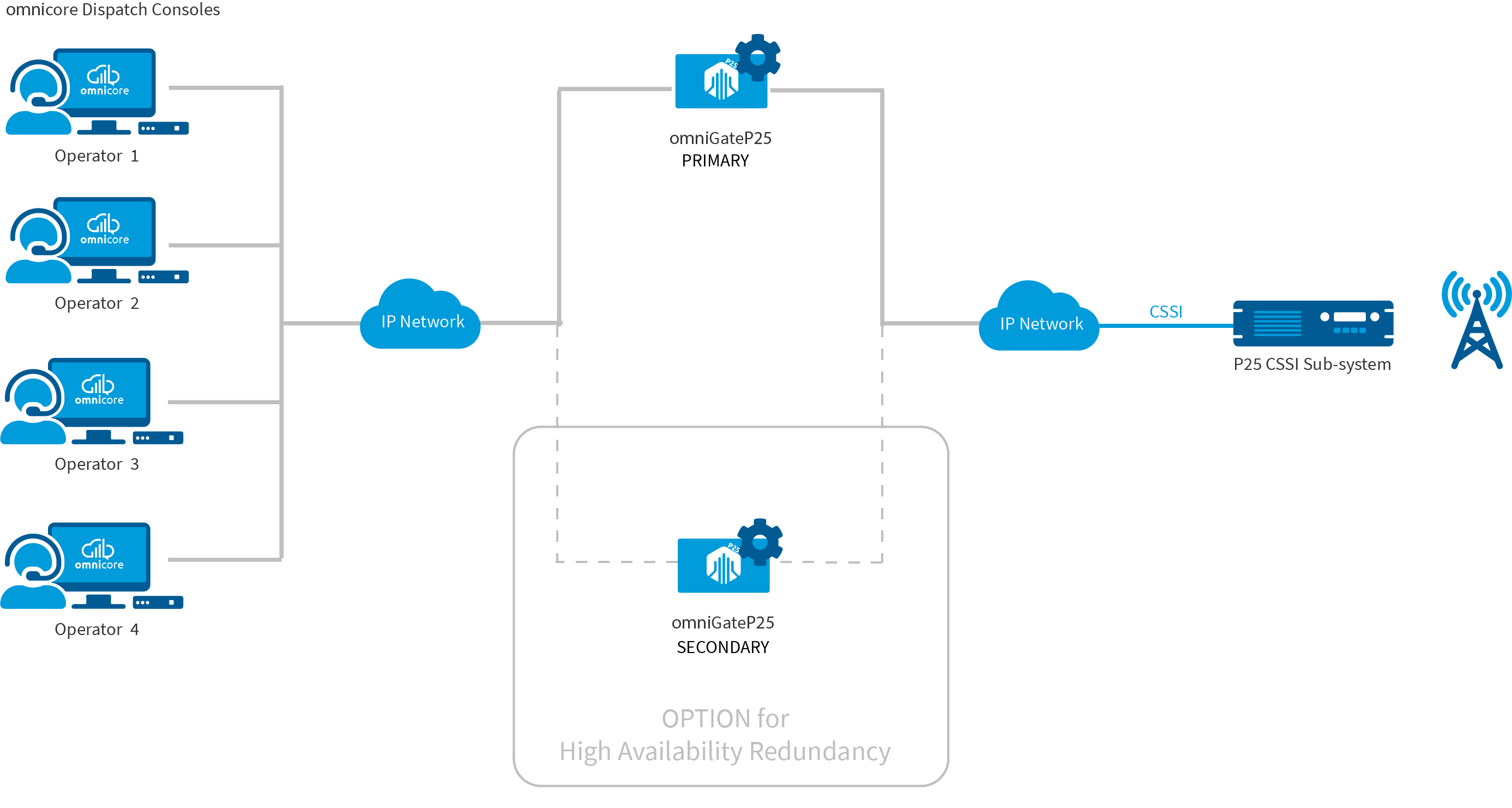
EXPLAINER
Benefits of P25 CSSI
P25 CSSI provides a unique level of flexibility when selecting the best console system solution. The open-architecture standard allows for interconnection of multiple types of consoles, audio systems, and other equipment from various manufacturers into one integrated communications architecture.
White Paper
Which Dispatch Solution?
With the large variety of dispatch consoles and solutions out there, not to mention the differing protocols and technologies, choosing the best dispatch console for your organization can be a confusing process.
Project 25 Technology Interest Group (PTIG)
Project 25 Frequently Asked Questions (FAQ)
Version 1.9 250603 | Copyright: Project 25 Technology Interest Group
Where can I view the latest list of P25 Standards Documents available?
The PTIG Home Page www.project25.org has a direct link to the current list of P25 Steering Committee approved P25 Standards documents The link can be accessed by clicking on the Blue Box on the PTIG home page for “P25 SC Approved list of Standards”.
What is Project 25 (P25)?
Project 25 (P25) is a suite of over 80 standards documents for the design and manufacture of interoperable digital Land Mobile Radio (LMR) wireless communications products. The Standards have been developed with state, local and federal government representatives, manufacturers and service providers all under Telecommunications Industry Association (TIA) governance.
P25 has gained worldwide acceptance for government, public safety, public service, military, transportation, utilities, and critical Infrastructure applications.
The published P25 standards suite is administered by the Telecommunications Industry Association (TIA Mobile and Personal Private Radio Standards Committee TR-8). Radio equipment that demonstrates compliance with P25 is able to meet requirements that fit the needs of public safety and government users.
Project 25 manufacturers take the features and specifications defined by the P25 Standards and implement them in reliable software, hosted on rugged hardware platforms that are exhaustively tested to ensure systems are reliant and resilient and that the Project 25 features and capabilities are available even under severe conditions.
Where can I get a copy of P25 Standards documents?
Copies of the Standards are free to Government Agencies in the United States. Follow this link for an application form
https://tiaonline.org/wp-ontent/uploads/2020/11/20240730-P25-Request-Form.pdf
For government agencies outside of the United States, please contact Victoria Mitchell at TIA using the link below: [email protected]
Documents for Commercial Entities can be ordered at: https://store.accuristech.com/tia
Where can I view the latest Changes and Updates to the P25 Standards and future work in progress?
The www.project25.org homepage has a direct link to a report on the latest P25 Standards update from the most recent TIA TR-8 meetings. The report can be downloaded using the blue box link on the PTIG home page for “Project 25 Standards Latest Update”. The site also has a link to the current list of P25 Steering Committee approved P25 Standards documents under the documents tab.
How do I find which operational requirements and features are covered in the P25 Suite of Standards?
TSB-102 document is an overview of the P25 suite of standards. That is the place to start and will provide guidance on P25/TIA-102 documents on specific interfaces and services.
Copies of the Standards are free to Government Agencies in the United States. Follow this link for an application form https://tiaonline.org/wp-content/uploads/2020/11/20240730-P25-Request-Form.pdf
For government agencies outside of the United States, please contact Victoria Mitchell at TIA using the link below: [email protected]
Documents for Commercial Entities can be ordered at: https://store.accuristech.com/tia
Are supplementary services in the P25 Standard available with multi-vendor offerings?
Yes. The TIA TSB-102 document is an overview of the P25 suite of standards. That is the place to start and will provide guidance on P25/TIA-102 documents on specific interfaces and services.
Consult vendors for their specific offerings.
What is the Project 25 Statement of User Needs (SPUN)?
The Statement of Project 25 (P25) User Needs (SPUN) is derived from the original P25 Statement of Requirements (SoR) document and describes user needs and P25 functionality from the perspective of P25 users. This new SPUN document provides high-level explanations of P25 system architecture, features, and functions as defined in the Telecommunications Industry Association (TIA) 102 Suite of Standards (P25 Standards) and as communicated by P25 public safety users and system administrators.
The SPUN was developed by the Project 25 Steering Committee with support from the Cybersecurity and Infrastructure Security Agency (CISA). The document is currently managed by the P25 Public Safety User Needs Working Group (PSUNWG).
The full document can be downloaded using the link below: https://www.project25.org/images/stories/ptig/Revised_Statement_of_P25_User_Needs_508_Approved_March_2024_1.pdf
This document offers a description of the P25 system model and the organization of P25 Standards documents to give users a baseline of current P25 capabilities and features. The SPUN also provides a framework for users to review, identity, and effectively communicate their needs to those involved in the standards-development process.
That said, not all services, features, and capabilities listed in the user needs tables are addressed by current P25 Standards and/or available on the market. In practice, most P25 systems do not include all the services, features, and capabilities described in the SPUN. This document is intended as a resource for understanding P25 Standards and user needs related to those standards. The lists of user needs should not be considered a complete or binding list of P25 requirements for procurement decisions. Finally, as technologies advance, new user needs likely will emerge and existing needs will be modified or removed.
How are P25 Standards documents created?
The P25 Suite of Standards is a library of over 80 documents and standards adopted by the P25 Steering Committee. The TIA-102 series of standards makes up the bulk of the P25 Standard. To date, all documents included in the suite of P25 Standard Documents are created and maintained by the TIA TR-8 Engineering Committee.
Creating a new P25 Standard document typically results from a sequential, but iterative, process between TIA TR-8 and P25 users as described below:
• The NCSWIC/SAFECOM P25 Public Safety User Needs Working Group (PSUNWG) identifies a need for a standard to enable interoperability of some “feature.” This may also be added to the Statement of Project 25 User Needs (SPUN);
• APIC Task Group (combination of manufacturers and NCSWIC/SAFECOM P25 Public Safety User Needs Working Group (PSUNWG) users develops a draft Standard;
• The associated TIA TR-8 Subcommittee including manufacturers and users from NCSWIC/SAFECOM P25 Public Safety User Needs Working Group (PSUNWG) prepare an official TIA-102 standard for publication based on the APIC draft;
• Project 25 Steering Committee adopts the TIA Standard as part of the suite of P25 Standards;
• TIA publishes and maintains the TIA-102 standard.
What is the difference between P25 Phase 1 and P25 Phase 2?
P25 Phase 1 should be referred to as FDMA (frequency division multiple access) and is available in both conventional and trunked systems while P25 Phase 2 should be referred to as TDMA (time division multiple access), and is only available in P25 trunked systems. P25 Phase 1 may also be known as “full rate” while Phase 2 may be known as “half rate.”
P25 Phase 1 allows for one voice or data transmission per RF channel at one time. P25 Phase 2 allows for two voice or data transmissions per RF channel.
P25 Phase 1 supports a single control channel per RF channel. P25 Phase 2 allows for one control channel that utilizes both TDMA time slots or a control channel and a voice or data transmission per RF channel.
TDMA trunked Data operation or Conventional Voice/Data channel are potential future work items dependent on user input/prioritization.
Project 25 Users should always inquire with P25 system/subscriber manufacturers for availability of any feature/function.
When will the P25 Standard be complete?
The P25 Standards are continually updated to address the evolving needs of users, and changing FCC, NTIA, and Global Regulatory requirements. The P25 Standard will continue to evolve with new specifications and clarifications that will resolve interoperability issues, add additional features, offer improved performance, add security upgrades, offer new testing specs, and create additional interfaces.
Where can I find a list of the known Project 25 Systems on the air Today?
PTIG members have identified over 3368 (2387 Conventional and 981 Trunked) P25 Systems that are operating world-wide on the air today, and more are in the planning stage The PTIG Home Page https://www.project25.org/ has a direct link to a current list of P25 Trunking Systems and a second list of P25 Conventional Systems. The links can be accessed by clicking on the Blue Boxes on the PTIG home page for “List of P25 Trunking Systems” and “List of P25 Conventional Systems”.
What is the DHS P25 Compliance Assessment Program (CAP)?
The P25 Compliance Assessment Program (P25 CAP) is a voluntary program for equipment manufacturers. The program is operated by the Office for Interoperability and Compatibility (OIC) within the Department of Homeland Security’s Science & Technology Directorate. Operating in a partnership with the P25 Standards process, P25CAP has established Compliance Assessment Bulletin (CAB) documents identifying the specific processes and tests required to show a piece of P25 equipment operates in compliance with the specified P25 Standards.
Manufacturers desiring to have their products included on DHS’ Approved Equipment List of equipment eligible for Federal Grant funding assistance to purchase will submit their products to DHS-recognized testing laboratories for “P25CAP Testing.”
Following this testing process, the manufacturers then submit their Supplier’s Declaration of Compliance (SDOC) and Summary Test Report (STR) documents to the P25CAP program office at DHS-S&T. These documents show the specific tests the item has passed (or does not support).
Once reviewed and accepted, these documents are then listed on DHS-S&T’s Approved (GrantEligible) Equipment page
https://www.dhs.gov/science-and-technology/approved-grant-eligible-equipment
Please note that equipment on this list has been tested only to the specific tests identified in the CAB documents. These CAB documents are available upon request to mailto:[email protected].
Where can I view CAP testing results?
P25 CAP testing results are posted on the DHS P25 website Approved (Grant-Eligible) Equipment list.
Send any questions about specific listings or other information to [email protected].
Are CAP tested products “Certified” to meet P25?
The word “Certified” is not used in the description of CAP testing by DHS, NIST, TIA, or the PTIG member companies. A more appropriate statement would be: “The posting of SDoCs & STRs on the DHS OIC P25 CAP website means that compliance of the referenced products has been assessed by testing for specific features, functions, and services listed in the P25 CAP Summary Test Report (STR), validated by a P25 CAP recognized P25 Test laboratory, and approved by DHS OIC to be posted on the DHS OIC P25 CAP website.”
https://www.dhs.gov/science-and-technology/p25-cap
If the SDOC and STR documents are not posted on the DHS website, they have yet to be approved by DHS OIC.
What does P25 Compliance mean?
In general, “Project 25 (P25) compliance” is typically interpreted as: “adherence to the P25 standard”.
The P25 Standard is composed of over 80 documents that cover multiple interfaces, multiple services and multiple features associated with each interface or service. Therefore, questions or statements about compliance to the “P25 standard” are too vague to provide the understanding typically desired by those asking the questions or making the statements.
Questions or statements about any level of compliance are more effectively expressed in the context of a specific interface, a specific service or a specific feature that is covered by a published P25 standard document or in the context of a specific standard document. For example, the statement: “My equipment is P25 compliant” is difficult to correctly interpret because it does not identify any P25 standard interface or service or document or set of features.
A better statement would be along the lines of: “My radio is compliant to the P25 FDMA Air Interface, Trunking service, Group Voice Call feature.”
4 levels of P25 compliance:
Compliance in the context of the Statement of P25 User Needs (SPUN) document
Compliance statements at this level mean functionality covered by the SPUN has been implemented.
Compliance in the context of a published P25 Standard document
Compliance statements at this level mean functionality has been implemented in accordance with a P25 Standard document or documents.
Compliance in the context of a published P25 Standard test document
Compliance statements at this level means functionality has been implemented per a P25 Standard document and has passed P25 standard tests associated with that functionality.
Compliance in the context of the DHS OIC Compliance Assessment Program (CAP)
The DHS OIC Compliance Assessment Program identifies equipment tests that may or may not be included in the P25 suite of standards. When CAP testing uses tests included in the P25 suite of standards, then compliance statements at this level means the tested functionality has been implemented per a P25 Standard document (or documents) and this functionality has passed its associated P25 standard tests that are included in CAP Compliance Assessment Bulletins (CABs) and the testing was performed in CAP recognized labs and the test results are reported in a CAP approved document.
How are P25 Test Documents created?
P25 Test standards are typically created by the appropriate TIA TR8 Committee along with the associated P25 standard in TIA subcommittees. These test standards are created alongside the other documents (like Messages & Procedures) in TIA subcommittees.
The P25 test documents ensure that under specific conditions and specific configurations, equipment built by different manufacturers will operate as prescribed by the published standards.
There are 3 types of test documents published:
• Performance Tests - These tests ensure that various aspects of Interface implementations are
interoperable and meet various regulatory requirements.
• Interoperability Tests - These tests ensure that various implementations of standard
interfaces, services and features provide the user functionality intended by the standard.
• Conformance Tests - These tests ensure that implementations of standard interfaces, services and features provide the intended functionality by adhering to the messages, message content and message exchanges prescribed by the standards.P25 CAP testing requirements are defined in the testing requirements section at
https://www.dhs.gov/science-and-technology/bulletins, which defines the tests required such as Performance, Conformance, and Interoperability for the type of equipment being tested.
What are RCATs ?
RCATS are TSBs, Telecommunications Systems Bulletins, and as such, are recommendations and not standards. The following describes how RCATS, Recommended Compliance Assessment Tests, are created. RCATs are drafted by the creators of the associated TIA Standards with Industry lead and consultation with User Agency representatives.
• Project 25 Steering Committee adopts the TIA RCAT TSB as part of the suite of P25 Standards.
• TIA publishes and maintains the P25 RCAT TSB.
• P25 Steering Committee forwards P25 RCAT TSB to the DHS Compliance Assessment Program (CAP) Advisory Panel (AP) for consideration during Compliance Assessment Bulletin (CAB) creation or modification.
What are CABs?
The Compliance Assessment Bulletins (CABs) are the official documents used in P25 CAP Test laboratories for testing. CABs are published by DHS OIC.
The P25CAP test standards have been revised and expanded several times over the past 10 years. How do I know my LMR equipment is still P25CAP compliant?
Understand and keep a record of the equipment versions that you have. Check the current CAP documentation for your equipment to determine if it covers your equipment versions and the CAB version that they were tested to.
What are the Benefits of Project 25?
Reliable Communications Interoperability for day-to-day operations and emergency management
• Cost Savings and Improved Geographic Coverage through sharing
• Large Installed Base of over 3300+ P25 Systems for mutual aid and incident management
• NIST FIPs 197 security endorsed by the US Government for AES encryption on all P25 security services
• Comprehensive Security: AES Voice and Data, Authentication, Link Layer Encryption, Key Management
• Flexible/Scalable P25 Architecture and Frequency Bands for Urban, Sub-Urban and Rural, VHF/UHF/700/800/900MHz
• Procurement Competition from more than 40+ Product and Service providers
An exploration of additional benefits and the value proposition for Project 25 can be found using the link below:
https://www.project25.org/index.php/why-choose-p25
PTIG has published a number of Whitepapers exploring the benefits of P25 including:
• Benefits of P25
• Is P25 Public Safety Grade?
• P25 Sharing Equals Cost Savings
• A good time to revisit P25 on the Fireground
These Whitepapers can be accessed using a link to the Directory on the PTIG website below:
https://www.project25.org/index.php/documents/p25-whitepapers?view=frontlist&catid[0]=1001
Is Project 25 Public Safety Grade?
Yes, for a number of reasons.
Public Safety Grade (PSG) equipment, systems, or networks are those that provide the communication capabilities required by the operators and users of the equipment with availability and reliability exceeding that typically provided by commercial communication equipment, systems, and networks.
The P25 Standard is designed for mission-critical operation as required by different markets, such as public safety (law enforcement, fire, EMS, state/local/federal/tribal and military), utilities, transit, and other business/industrial sectors.
The P25 standard is developed based on public safety input. The P25 market features multiple suppliers that offer P25 equipment designed for mission-critical operations by public safety customers. P25 systems are used by a wide variety of customers including public safety.
The 33 + Project 25 Systems deployed and operating today can be characterized as “Public Safety Grade” based on their adherence to a Public Safety Driven P25 Suite of Standards and the resilient and redundant architecture utilized in the infrastructure, facilities, comm centers, and sites
operating today.
For more details on Project 25 as a Public Safety Grade technology a link to the White paper “Is Project 25 Public Safety Grade?” can be found in the PTIG website directory below:
https://www.project25.org/index.php/documents/p25-whitepapers?view=frontlist&catid[0]=10016
What are the benefits of using P25 radio equipment on the Fire ground?
Benefits of using P25 mission critical radio equipment on the Fire ground include:
- The dual-rate vocoder developed for P25 Phase 2 included improved performance in background noise. Manufacturers have also added background noise reduction algorithms to their radio products in addition to the vocoder improvements. P25 equipment can achieve as much as 25 dB improvements in background noise reduction.
- Tone Signaling – DTMF, Knox and single tone, and Two tone Sequential signaling is supported in the P25 vocoder.
- Improved Coverage – P25 FDMA technology has been shown to provide better coverage than Analog.
- Enhanced Signaling compared to Analog – Talking Party ID, Group Calls, Unit-to-Unit Calls, All Calls, Emergency Alerts, Emergency Calls, Call Alerts, Radio Check, Radio Unit Monitoring and others.
- Manufacturers have developed P25 Pagers, P25 Fire Station Alerting and Siren Controllers and have added Integrated GPS receivers into P25 portable radio products to provide location information.
- P25 offers interoperable services with other first responders and agencies at the scene.
What are the key considerations for purchasing interoperable P25 equipment?
Purchasing P25 equipment that has been assessed and approved under the P25 Compliance Assessment Program (CAP) is the best way to ensure P25 equipment is interoperable. A list of approved grant-eligible P25 equipment is available on the Department of Homeland Security (DHS) website.
However, interoperable communications extend beyond P25 equipment. The SAFECOM Interoperability Continuum is designed to assist emergency response agencies and policy makers to plan and implement interoperability solutions for data and voice communications. This tool identifies five critical success elements that must be addressed to achieve a sophisticated interoperability solution: governance, standard operating procedures (SOPs)/standard operating guidelines (SOGs) and field operations guides (FOGs), technology, training and exercises, and usage of interoperable communications. Jurisdictions can use the Interoperability Continuum to track progress in strengthening interoperable communications.
More details on each of five elements is available in the SAFECOM Interoperability Continuum brochure: https://www.cisa.gov/resources-tools/resources/interoperability-continuum
Interoperability Best Practices:
Define your needs. Familiarize yourself with standard offerings that serve your needs. Specify your desired capabilities and user interface. Engage vendors and validate interoperability via testing, then purchase.
Note: Sometimes vendors’ implementations of a feature are P25 compliant but not identical for the User. The look and feel of a P25 implementation i.e., the ergonomics of a device and user experience is not defined by the standard. Thus, while P25 features/functions may work the same, the User interface and experience of a device will vary between manufacturers. There are some common elements that are often implemented (for example the usage of a channel selector knob or PTT button in a SU) but these are not strictly required by the standard.
We are going to a new P25 system in our rural area. All of the systems around us are conventional analog. How can we interoperate?
A variety of manufacturers offer multi-band, multi-mode subscriber units capable of P25 Phase 1, P25 Phase 2, and analog channels. In addition, there are numerous interoperability products and consoles that provide hard and soft patches between conventional and P25 trunking. Other network vendors also support mapping from conventional to trunking user groups without patching. The full range of solutions can be found through links on the PTIG P25 Products and Services Matrix. A link to the matrix is below.
https://www.project25.org/index.php/products/p25-supplier-matrix
A new P25 system is building out in my region. I have a P25 radio, how do I get access?
The systems operator of your regional P25 network is the key to access for new users. Most have standard policies and procedures to accomplish this. Call them to understand the things that can affect your ability to get access: Radio programming policy, frequency band used by the system, if the system is a P25 Phase 1 or P25 Phase 2 system, and what the rev level is for the system’s trunking software. Many systems have already tested and approved specific P25 subscriber units for operation on their system from multiple vendors. This list should be available. Some systems permit some, but not all makes/models of P25 radios. Most P25 System operators require testing on their system to receive approval to operate.
How do I migrate my old proprietary trunking system to P25?
Your organization should start by capturing user needs and defining options that are both operationally and commercially in your organization’s best interests. A variety of consultants with extensive Project 25 experience are available if your organization requires assistance with this process. A variety of manufacturers offer interoperability products, network bridges and patches.
Other network vendors also support mapping from conventional to trunking user groups without patching.
The full range of solutions can be found through links on the PTIG P25 Products and Services Matrix. A link to the matrix is below:
https://www.project25.org/index.php/products/p25-supplier-matrix
Who do I talk to about P25 interoperability issues between different vendors? Who can help?
Contact the PTIG director who will query the involved vendors for possible solutions. mailto:[email protected].
Each State in the USA has a designated “State-wide Interoperability Coordinator” (SWIC). They can offer potential resolution to interoperability issues in your state. A list is available using the link below.
https://www.cisa.gov/safecom/ncswic-membership A variety of consultants with extensive Project 25 experience are available to assist you.
What is the difference between Automatic roaming and Manual roaming in a P25 System?
From the perspective of the user, “automatic roaming” refers to the radio’s ability to move from the coverage of one RF site or system to another without user intervention (or often even user knowledge). The user’s radio automatically knows when coverage is degrading, it automatically searches for better coverage, and then automatically switches and registers with the new RF site’s control channel.
Alternatively, “manual roaming” from the user’s perspective requires the user to physically select the new site, or system using radio control methods (i.e. menu, selector, etc.). The radio then tunes to the newly selected site frequency and attempts to register on the new RF site’s control channel.
Identity management programming for the roaming radios and infrastructure is key to successful reliable roaming. A Whitepaper on P25 Roaming and Identity Management is available at
https://www.project25.org/index.php/documents/p25-whitepapers?view=frontlist&catid[0]=10016
How will I know I have interoperability with other agencies during an event?
Prior to known events and on an ongoing basis, collaborate with neighboring agencies to compare system set up and programming parameters. Conduct tests for various scenarios to ensure interoperability. Changes in standards, testing, hardware, firmware, features and services may affect your interoperability.
P25 equipment manufacturers have been continuously introducing new products and features. Our system is a few years old; will we still have interoperability?
The CAP documents will tell which new features and software releases have been tested for interoperability between manufacturers. Good communication with your neighboring jurisdictions and the manufacturers is strongly recommended. Check with your consultant or P25 Equipment manufacturer for the latest documentation and ensure your equipment has been updated to the latest software and about how they ensure new products are compliant and their programs to keep legacy equipment up to date.
I am thinking about buying P25 equipment. For the purposes of multimanufacturer interoperability, what should I Consider?
Check that the features or interfaces that you are interested in are covered by the published standards. Check that the manufacturers that you are interested in have implemented these features or interfaces to the published standards. Check to see if the manufacturers of interest have tested the features and interfaces that you require.
What do I need to consider to permit multiple portable and mobile radio vendors on a P25 System?
This is ultimately up to the system operator, but in general, radios must operate in the frequency band used for the system. In addition, the subscriber unit features offered should be compared to the features required within the system. When offered features match required features, requesting interoperability test data from the specific manufacturers is recommended. Project 25 Phase 1 FDMA and Phase 2 TDMA Subscriber compatibility and Interoperability for different vendors and different software revision levels can be confirmed using CAP test data found on the DHS website https://www.dhs.gov/science-and-technology/p25-cap
Contact potential vendors to confirm their position on interoperability with other P25 products and systems.
Best results for interoperability and sharing occur when the radios are programmed to offer common channel/Talk group names and zone architecture. Enabled features should be consistent when possible; all features do not have to be offered to all user groups.
Are there any examples of P25 systems on the air today with multiple vendor subscriber units approved for operation on the system?
PTIG members have identified more than 3300+ (Conventional and Trunked) P25 Systems on the air today, and more are in the planning stage. Many have multiple vendors’ P25 subscriber units approved for use on their systems. Alaska, Wyoming, Michigan, Connecticut, Pennsylvania, New
Mexico, Ohio, Dallas/Fort Worth, The City of Wichita, and Lancaster County PA are just a few examples of systems using multiple vendor subscriber units.
I currently am on a conventional analog system. A new P25 trunking system is available in my area. What choices do I have for subscriber units that will work with both analog and P25?
Project 25 subscriber units typically include backward compatibility to analog operation.
If your system and the P25 system are in the same frequency band you can choose a single band radio. P25 Multi band radios multi-mode radios are available for interoperability between systems with different frequency bands (example 700/800 MHz trunking to VHF 136-174 MHz conventional).
In addition, Interoperability products can create hard patches between conventional analog and P25 trunking. Other network vendors also support mapping from conventional to trunking user groups without patching. See the PTIG WEB project25.org Products Tab:
https://www.project25.org/index.php/products/p25-supplier-matrix for a full range of solutions.
Why do we have a P25 system but my system operator says we can only buy one brand of radio?
The P25 Common Air Interface supports interoperability between the RFSS and Subscriber Units from different manufacturers. Furthermore, there are numerous examples of deployed P25 systems that offer choice in P25 subscribers. Of course, specific subscribers available on each system are dependent on operator policy.
Many agencies are currently operating with products from multiple vendors on the open P25 Standard. There are 15 infrastructure suppliers and 14 subscriber unit suppliers building Project 25 equipment. If you can buy only one brand it may be because it is the policy of your system operator based on the economics of maintaining multiple brands of equipment. Or it may be that you have manufacturer specific features or capabilities in your system that are offered by only one vendor and are not covered by the Project 25 suite of standards.
Are there any examples of P25 system infrastructure from different vendors linked to make a single system?
Yes. Examples include a Dallas/Fort Worth 7 MHz “overlay” that uses multiple vendors’ subsystems linked using the P25 ISSI interface. A number of similar deployments are in place or in planning including in Connecticut, Florida, Oklahoma, Denver Region and Southern Texas.
If I have one manufacturer’s P25 trunked RF Subsystem (RFSS), can I use a different manufacturer’s consoles?
Yes, if your RFSS includes a Console Subsystem Interface (CSSI). As long as the RF and the console manufacturer’s systems both support the P25 CSSI standard, you can pick whichever RFSS and Console System that best suits your needs. However, it is prudent to consult with both manufacturers to verify: if the requested console is supported, if the system will support it, if there is capacity, and if testing has been completed to verify the supported P25 features. Note that some radio system manufacturers may implement non-standard features to consider.
Are there real-life examples of P25 Trunked RF Subsystems from one manufacturer being connected to a console system of another manufacturer using the P25 CSSI?
Yes, P25 manufacturers have implemented the P25 CSSI to connect a console system to P25 trunked networks. Many P25 deployments in the United States and around the globe have implemented this integration. The P25 CAP website is the best place to find products that are compliant with P25 CSSI equipment testing.
If I am connecting to a single manufacturer’s P25 Conventional RF Subsystem (RFSS) or Conventional Console Subsystem (CSS) can I connect a base station or repeater from a different manufacturer?
Yes, if your RFSS/CSS provides a Conventional Fixed Station Host and the Fixed Station manufacturer supports the Fixed Station Interface (FSI). See TIA-102.BAHA - Fixed Station Interface for further information.
What Security interfaces and services are currently covered by the P25 standards?
Improved security has been a recent focus, and much progress has been made in recent years to add new capabilities to increase P25 security. Project 25 today offers “Defense in Depth” through the use of the multiple Security Services detailed below:
• End-to-end 256-bit AES encryption offers secure, interoperable exchange of voice and data across the P25 LMR infrastructure and its associated network.
• Link Layer Authentication (LLA) validates the identity of subscriber units (SUs) and may validate Infrastructure, if supported, to ensure they are legitimate.
• Link Layer Encryption (LLE, currently in development) will offer Cyber-security for over-the-air signaling.
• Key Management Facilities (KMF) and Over-the-air-Rekeying (OTAR) work together to manage encryption.
• Updated standards support the Inter-KMF-Interface (IKI) transferring encryption key material online or offline between separate systems/KMFs.
• Updated standards for the Key Fill Interface (KFI) support transfer of encryption key material securely from a key fill device to all other key depositories in a P25 System.
• Over-the-air-Rekeying (OTAR) delivers new encryption key material over P25 common air interface
Where can I find information on Best Practices for P25 Security, programming, and Key management?
The PTIG Home Page https://www.project25.org/ has a direct link to a Library of documents on P25 Security and Encryption, and Key Management. The link can be accessed by clicking on the Blue Box on the PTIG home page for “P25 Security and Encryption”.
Do broadband data networks make P25 obsolete?
No, the technologies complement one another and will be “Better Together” for the foreseeable future. Many Public Safety and Industry technology experts and organizations, including the National Public Safety Telecommunications Council (NPSTC) and DHS Office of Emergency
Communications, are on the record that Project 25 is the standard for government and public safety communication systems today and will remain as the primary technology for secure interoperable voice systems for decades to come.
Broadband for Public Safety technologies are now offering many valuable and exciting new interoperable voice & data services. Today the technologies are being merged at both the infrastructure and subscriber unit level.
Are there Standards for LMR-LTE Interworking?
P25 Standards are being adapted to enable the interworking of common Standard services. The Telecommunications Industry Association (TIA) and the Alliance for Telecommunications Industry Solutions (ATIS) resumed work on standards for the interworking of mission-critical LTE and LMR services in late 2017, with a project committee known as Joint Land Mobile Radio Long Term Evolution (JLMRLTE). The current JLMRLTE work item is titled the “Study of Interworking between
P25 LMR and 3GPP (MCPTT) Mission Critical Services”.
This document contains scenarios and considerations for the use of a 3GPP Release 15 Inter Working Function (IWF) to enable interoperability of standards services between a 3GPP mission-critical standards-based LTE system and a TIA standards based LMR system. TIA standards based LMR
systems being considered are: P25/TIA-102 Trunking, P25/TIA-102 Conventional, and TIA-603 analog conventional FM.
The Interworking Study document does not prescribe a particular LMR interface to the IWF although the P25 Inter-RF Subsystem Interface (ISSI) and Digital Fixed Station Interface (DFSI) have been chosen by TIA.
Project 25 Technology Interest Group (PTIG)
Project 25 Frequently Asked Questions (FAQ)
Version 1.9 250603 | Copyright: Project 25 Technology Interest Group
Where can I view the latest list of P25 Standards Documents available?
The PTIG Home Page www.project25.org has a direct link to the current list of P25 Steering Committee approved P25 Standards documents The link can be accessed by clicking on the Blue Box on the PTIG home page for “P25 SC Approved list of Standards”.
What is Project 25 (P25)?
Project 25 (P25) is a suite of over 80 standards documents for the design and manufacture of interoperable digital Land Mobile Radio (LMR) wireless communications products. The Standards have been developed with state, local and federal government representatives, manufacturers and service providers all under Telecommunications Industry Association (TIA) governance.
P25 has gained worldwide acceptance for government, public safety, public service, military, transportation, utilities, and critical Infrastructure applications.
The published P25 standards suite is administered by the Telecommunications Industry Association (TIA Mobile and Personal Private Radio Standards Committee TR-8). Radio equipment that demonstrates compliance with P25 is able to meet requirements that fit the needs of public safety and government users.
Project 25 manufacturers take the features and specifications defined by the P25 Standards and implement them in reliable software, hosted on rugged hardware platforms that are exhaustively tested to ensure systems are reliant and resilient and that the Project 25 features and capabilities are available even under severe conditions.
Where can I get a copy of P25 Standards documents?
Copies of the Standards are free to Government Agencies in the United States. Follow this link for an application form
https://tiaonline.org/wp-ontent/uploads/2020/11/20240730-P25-Request-Form.pdf
For government agencies outside of the United States, please contact Victoria Mitchell at TIA using the link below: [email protected]
Documents for Commercial Entities can be ordered at: https://store.accuristech.com/tia
Where can I view the latest Changes and Updates to the P25 Standards and future work in progress?
The www.project25.org homepage has a direct link to a report on the latest P25 Standards update from the most recent TIA TR-8 meetings. The report can be downloaded using the blue box link on the PTIG home page for “Project 25 Standards Latest Update”. The site also has a link to the current list of P25 Steering Committee approved P25 Standards documents under the documents tab.
How do I find which operational requirements and features are covered in the P25 Suite of Standards?
TSB-102 document is an overview of the P25 suite of standards. That is the place to start and will provide guidance on P25/TIA-102 documents on specific interfaces and services.
Copies of the Standards are free to Government Agencies in the United States. Follow this link for an application form https://tiaonline.org/wp-content/uploads/2020/11/20240730-P25-Request-Form.pdf
For government agencies outside of the United States, please contact Victoria Mitchell at TIA using the link below: [email protected]
Documents for Commercial Entities can be ordered at: https://store.accuristech.com/tia
Are supplementary services in the P25 Standard available with multi-vendor offerings?
Yes. The TIA TSB-102 document is an overview of the P25 suite of standards. That is the place to start and will provide guidance on P25/TIA-102 documents on specific interfaces and services.
Consult vendors for their specific offerings.
What is the Project 25 Statement of User Needs (SPUN)?
The Statement of Project 25 (P25) User Needs (SPUN) is derived from the original P25 Statement of Requirements (SoR) document and describes user needs and P25 functionality from the perspective of P25 users. This new SPUN document provides high-level explanations of P25 system architecture, features, and functions as defined in the Telecommunications Industry Association (TIA) 102 Suite of Standards (P25 Standards) and as communicated by P25 public safety users and system administrators.
The SPUN was developed by the Project 25 Steering Committee with support from the Cybersecurity and Infrastructure Security Agency (CISA). The document is currently managed by the P25 Public Safety User Needs Working Group (PSUNWG).
The full document can be downloaded using the link below: https://www.project25.org/images/stories/ptig/Revised_Statement_of_P25_User_Needs_508_Approved_March_2024_1.pdf
This document offers a description of the P25 system model and the organization of P25 Standards documents to give users a baseline of current P25 capabilities and features. The SPUN also provides a framework for users to review, identity, and effectively communicate their needs to those involved in the standards-development process.
That said, not all services, features, and capabilities listed in the user needs tables are addressed by current P25 Standards and/or available on the market. In practice, most P25 systems do not include all the services, features, and capabilities described in the SPUN. This document is intended as a resource for understanding P25 Standards and user needs related to those standards. The lists of user needs should not be considered a complete or binding list of P25 requirements for procurement decisions. Finally, as technologies advance, new user needs likely will emerge and existing needs will be modified or removed.
How are P25 Standards documents created?
The P25 Suite of Standards is a library of over 80 documents and standards adopted by the P25 Steering Committee. The TIA-102 series of standards makes up the bulk of the P25 Standard. To date, all documents included in the suite of P25 Standard Documents are created and maintained by the TIA TR-8 Engineering Committee.
Creating a new P25 Standard document typically results from a sequential, but iterative, process between TIA TR-8 and P25 users as described below:
• The NCSWIC/SAFECOM P25 Public Safety User Needs Working Group (PSUNWG) identifies a need for a standard to enable interoperability of some “feature.” This may also be added to the Statement of Project 25 User Needs (SPUN);
• APIC Task Group (combination of manufacturers and NCSWIC/SAFECOM P25 Public Safety User Needs Working Group (PSUNWG) users develops a draft Standard;
• The associated TIA TR-8 Subcommittee including manufacturers and users from NCSWIC/SAFECOM P25 Public Safety User Needs Working Group (PSUNWG) prepare an official TIA-102 standard for publication based on the APIC draft;
• Project 25 Steering Committee adopts the TIA Standard as part of the suite of P25 Standards;
• TIA publishes and maintains the TIA-102 standard.
What is the difference between P25 Phase 1 and P25 Phase 2?
P25 Phase 1 should be referred to as FDMA (frequency division multiple access) and is available in both conventional and trunked systems while P25 Phase 2 should be referred to as TDMA (time division multiple access), and is only available in P25 trunked systems. P25 Phase 1 may also be known as “full rate” while Phase 2 may be known as “half rate.”
P25 Phase 1 allows for one voice or data transmission per RF channel at one time. P25 Phase 2 allows for two voice or data transmissions per RF channel.
P25 Phase 1 supports a single control channel per RF channel. P25 Phase 2 allows for one control channel that utilizes both TDMA time slots or a control channel and a voice or data transmission per RF channel.
TDMA trunked Data operation or Conventional Voice/Data channel are potential future work items dependent on user input/prioritization.
Project 25 Users should always inquire with P25 system/subscriber manufacturers for availability of any feature/function.
When will the P25 Standard be complete?
The P25 Standards are continually updated to address the evolving needs of users, and changing FCC, NTIA, and Global Regulatory requirements. The P25 Standard will continue to evolve with new specifications and clarifications that will resolve interoperability issues, add additional features, offer improved performance, add security upgrades, offer new testing specs, and create additional interfaces.
Where can I find a list of the known Project 25 Systems on the air Today?
PTIG members have identified over 3368 (2387 Conventional and 981 Trunked) P25 Systems that are operating world-wide on the air today, and more are in the planning stage The PTIG Home Page https://www.project25.org/ has a direct link to a current list of P25 Trunking Systems and a second list of P25 Conventional Systems. The links can be accessed by clicking on the Blue Boxes on the PTIG home page for “List of P25 Trunking Systems” and “List of P25 Conventional Systems”.
What is the DHS P25 Compliance Assessment Program (CAP)?
The P25 Compliance Assessment Program (P25 CAP) is a voluntary program for equipment manufacturers. The program is operated by the Office for Interoperability and Compatibility (OIC) within the Department of Homeland Security’s Science & Technology Directorate. Operating in a partnership with the P25 Standards process, P25CAP has established Compliance Assessment Bulletin (CAB) documents identifying the specific processes and tests required to show a piece of P25 equipment operates in compliance with the specified P25 Standards.
Manufacturers desiring to have their products included on DHS’ Approved Equipment List of equipment eligible for Federal Grant funding assistance to purchase will submit their products to DHS-recognized testing laboratories for “P25CAP Testing.”
Following this testing process, the manufacturers then submit their Supplier’s Declaration of Compliance (SDOC) and Summary Test Report (STR) documents to the P25CAP program office at DHS-S&T. These documents show the specific tests the item has passed (or does not support).
Once reviewed and accepted, these documents are then listed on DHS-S&T’s Approved (GrantEligible) Equipment page
https://www.dhs.gov/science-and-technology/approved-grant-eligible-equipment
Please note that equipment on this list has been tested only to the specific tests identified in the CAB documents. These CAB documents are available upon request to mailto:[email protected].
Where can I view CAP testing results?
P25 CAP testing results are posted on the DHS P25 website Approved (Grant-Eligible) Equipment list.
Send any questions about specific listings or other information to [email protected].
Are CAP tested products “Certified” to meet P25?
The word “Certified” is not used in the description of CAP testing by DHS, NIST, TIA, or the PTIG member companies. A more appropriate statement would be: “The posting of SDoCs & STRs on the DHS OIC P25 CAP website means that compliance of the referenced products has been assessed by testing for specific features, functions, and services listed in the P25 CAP Summary Test Report (STR), validated by a P25 CAP recognized P25 Test laboratory, and approved by DHS OIC to be posted on the DHS OIC P25 CAP website.”
https://www.dhs.gov/science-and-technology/p25-cap
If the SDOC and STR documents are not posted on the DHS website, they have yet to be approved by DHS OIC.
What does P25 Compliance mean?
In general, “Project 25 (P25) compliance” is typically interpreted as: “adherence to the P25 standard”.
The P25 Standard is composed of over 80 documents that cover multiple interfaces, multiple services and multiple features associated with each interface or service. Therefore, questions or statements about compliance to the “P25 standard” are too vague to provide the understanding typically desired by those asking the questions or making the statements.
Questions or statements about any level of compliance are more effectively expressed in the context of a specific interface, a specific service or a specific feature that is covered by a published P25 standard document or in the context of a specific standard document. For example, the statement: “My equipment is P25 compliant” is difficult to correctly interpret because it does not identify any P25 standard interface or service or document or set of features.
A better statement would be along the lines of: “My radio is compliant to the P25 FDMA Air Interface, Trunking service, Group Voice Call feature.”
4 levels of P25 compliance:
Compliance in the context of the Statement of P25 User Needs (SPUN) document
Compliance statements at this level mean functionality covered by the SPUN has been implemented.
Compliance in the context of a published P25 Standard document
Compliance statements at this level mean functionality has been implemented in accordance with a P25 Standard document or documents.
Compliance in the context of a published P25 Standard test document
Compliance statements at this level means functionality has been implemented per a P25 Standard document and has passed P25 standard tests associated with that functionality.
Compliance in the context of the DHS OIC Compliance Assessment Program (CAP)
The DHS OIC Compliance Assessment Program identifies equipment tests that may or may not be included in the P25 suite of standards. When CAP testing uses tests included in the P25 suite of standards, then compliance statements at this level means the tested functionality has been implemented per a P25 Standard document (or documents) and this functionality has passed its associated P25 standard tests that are included in CAP Compliance Assessment Bulletins (CABs) and the testing was performed in CAP recognized labs and the test results are reported in a CAP approved document.
How are P25 Test Documents created?
P25 Test standards are typically created by the appropriate TIA TR8 Committee along with the associated P25 standard in TIA subcommittees. These test standards are created alongside the other documents (like Messages & Procedures) in TIA subcommittees.
The P25 test documents ensure that under specific conditions and specific configurations, equipment built by different manufacturers will operate as prescribed by the published standards.
There are 3 types of test documents published:
• Performance Tests - These tests ensure that various aspects of Interface implementations are
interoperable and meet various regulatory requirements.
• Interoperability Tests - These tests ensure that various implementations of standard
interfaces, services and features provide the user functionality intended by the standard.
• Conformance Tests - These tests ensure that implementations of standard interfaces, services and features provide the intended functionality by adhering to the messages, message content and message exchanges prescribed by the standards.P25 CAP testing requirements are defined in the testing requirements section at
https://www.dhs.gov/science-and-technology/bulletins, which defines the tests required such as Performance, Conformance, and Interoperability for the type of equipment being tested.
What are RCATs ?
RCATS are TSBs, Telecommunications Systems Bulletins, and as such, are recommendations and not standards. The following describes how RCATS, Recommended Compliance Assessment Tests, are created. RCATs are drafted by the creators of the associated TIA Standards with Industry lead and consultation with User Agency representatives.
• Project 25 Steering Committee adopts the TIA RCAT TSB as part of the suite of P25 Standards.
• TIA publishes and maintains the P25 RCAT TSB.
• P25 Steering Committee forwards P25 RCAT TSB to the DHS Compliance Assessment Program (CAP) Advisory Panel (AP) for consideration during Compliance Assessment Bulletin (CAB) creation or modification.
What are CABs?
The Compliance Assessment Bulletins (CABs) are the official documents used in P25 CAP Test laboratories for testing. CABs are published by DHS OIC.
The P25CAP test standards have been revised and expanded several times over the past 10 years. How do I know my LMR equipment is still P25CAP compliant?
Understand and keep a record of the equipment versions that you have. Check the current CAP documentation for your equipment to determine if it covers your equipment versions and the CAB version that they were tested to.
What are the Benefits of Project 25?
Reliable Communications Interoperability for day-to-day operations and emergency management
• Cost Savings and Improved Geographic Coverage through sharing
• Large Installed Base of over 3300+ P25 Systems for mutual aid and incident management
• NIST FIPs 197 security endorsed by the US Government for AES encryption on all P25 security services
• Comprehensive Security: AES Voice and Data, Authentication, Link Layer Encryption, Key Management
• Flexible/Scalable P25 Architecture and Frequency Bands for Urban, Sub-Urban and Rural, VHF/UHF/700/800/900MHz
• Procurement Competition from more than 40+ Product and Service providers
An exploration of additional benefits and the value proposition for Project 25 can be found using the link below:
https://www.project25.org/index.php/why-choose-p25
PTIG has published a number of Whitepapers exploring the benefits of P25 including:
• Benefits of P25
• Is P25 Public Safety Grade?
• P25 Sharing Equals Cost Savings
• A good time to revisit P25 on the Fireground
These Whitepapers can be accessed using a link to the Directory on the PTIG website below:
https://www.project25.org/index.php/documents/p25-whitepapers?view=frontlist&catid[0]=1001
Is Project 25 Public Safety Grade?
Yes, for a number of reasons.
Public Safety Grade (PSG) equipment, systems, or networks are those that provide the communication capabilities required by the operators and users of the equipment with availability and reliability exceeding that typically provided by commercial communication equipment, systems, and networks.
The P25 Standard is designed for mission-critical operation as required by different markets, such as public safety (law enforcement, fire, EMS, state/local/federal/tribal and military), utilities, transit, and other business/industrial sectors.
The P25 standard is developed based on public safety input. The P25 market features multiple suppliers that offer P25 equipment designed for mission-critical operations by public safety customers. P25 systems are used by a wide variety of customers including public safety.
The 33 + Project 25 Systems deployed and operating today can be characterized as “Public Safety Grade” based on their adherence to a Public Safety Driven P25 Suite of Standards and the resilient and redundant architecture utilized in the infrastructure, facilities, comm centers, and sites
operating today.
For more details on Project 25 as a Public Safety Grade technology a link to the White paper “Is Project 25 Public Safety Grade?” can be found in the PTIG website directory below:
https://www.project25.org/index.php/documents/p25-whitepapers?view=frontlist&catid[0]=10016
What are the benefits of using P25 radio equipment on the Fire ground?
Benefits of using P25 mission critical radio equipment on the Fire ground include:
- The dual-rate vocoder developed for P25 Phase 2 included improved performance in background noise. Manufacturers have also added background noise reduction algorithms to their radio products in addition to the vocoder improvements. P25 equipment can achieve as much as 25 dB improvements in background noise reduction.
- Tone Signaling – DTMF, Knox and single tone, and Two tone Sequential signaling is supported in the P25 vocoder.
- Improved Coverage – P25 FDMA technology has been shown to provide better coverage than Analog.
- Enhanced Signaling compared to Analog – Talking Party ID, Group Calls, Unit-to-Unit Calls, All Calls, Emergency Alerts, Emergency Calls, Call Alerts, Radio Check, Radio Unit Monitoring and others.
- Manufacturers have developed P25 Pagers, P25 Fire Station Alerting and Siren Controllers and have added Integrated GPS receivers into P25 portable radio products to provide location information.
- P25 offers interoperable services with other first responders and agencies at the scene.
What are the key considerations for purchasing interoperable P25 equipment?
Purchasing P25 equipment that has been assessed and approved under the P25 Compliance Assessment Program (CAP) is the best way to ensure P25 equipment is interoperable. A list of approved grant-eligible P25 equipment is available on the Department of Homeland Security (DHS) website.
However, interoperable communications extend beyond P25 equipment. The SAFECOM Interoperability Continuum is designed to assist emergency response agencies and policy makers to plan and implement interoperability solutions for data and voice communications. This tool identifies five critical success elements that must be addressed to achieve a sophisticated interoperability solution: governance, standard operating procedures (SOPs)/standard operating guidelines (SOGs) and field operations guides (FOGs), technology, training and exercises, and usage of interoperable communications. Jurisdictions can use the Interoperability Continuum to track progress in strengthening interoperable communications.
More details on each of five elements is available in the SAFECOM Interoperability Continuum brochure: https://www.cisa.gov/resources-tools/resources/interoperability-continuum
Interoperability Best Practices:
Define your needs. Familiarize yourself with standard offerings that serve your needs. Specify your desired capabilities and user interface. Engage vendors and validate interoperability via testing, then purchase.
Note: Sometimes vendors’ implementations of a feature are P25 compliant but not identical for the User. The look and feel of a P25 implementation i.e., the ergonomics of a device and user experience is not defined by the standard. Thus, while P25 features/functions may work the same, the User interface and experience of a device will vary between manufacturers. There are some common elements that are often implemented (for example the usage of a channel selector knob or PTT button in a SU) but these are not strictly required by the standard.
We are going to a new P25 system in our rural area. All of the systems around us are conventional analog. How can we interoperate?
A variety of manufacturers offer multi-band, multi-mode subscriber units capable of P25 Phase 1, P25 Phase 2, and analog channels. In addition, there are numerous interoperability products and consoles that provide hard and soft patches between conventional and P25 trunking. Other network vendors also support mapping from conventional to trunking user groups without patching. The full range of solutions can be found through links on the PTIG P25 Products and Services Matrix. A link to the matrix is below.
https://www.project25.org/index.php/products/p25-supplier-matrix
A new P25 system is building out in my region. I have a P25 radio, how do I get access?
The systems operator of your regional P25 network is the key to access for new users. Most have standard policies and procedures to accomplish this. Call them to understand the things that can affect your ability to get access: Radio programming policy, frequency band used by the system, if the system is a P25 Phase 1 or P25 Phase 2 system, and what the rev level is for the system’s trunking software. Many systems have already tested and approved specific P25 subscriber units for operation on their system from multiple vendors. This list should be available. Some systems permit some, but not all makes/models of P25 radios. Most P25 System operators require testing on their system to receive approval to operate.
How do I migrate my old proprietary trunking system to P25?
Your organization should start by capturing user needs and defining options that are both operationally and commercially in your organization’s best interests. A variety of consultants with extensive Project 25 experience are available if your organization requires assistance with this process. A variety of manufacturers offer interoperability products, network bridges and patches.
Other network vendors also support mapping from conventional to trunking user groups without patching.
The full range of solutions can be found through links on the PTIG P25 Products and Services Matrix. A link to the matrix is below:
https://www.project25.org/index.php/products/p25-supplier-matrix
Who do I talk to about P25 interoperability issues between different vendors? Who can help?
Contact the PTIG director who will query the involved vendors for possible solutions. mailto:[email protected].
Each State in the USA has a designated “State-wide Interoperability Coordinator” (SWIC). They can offer potential resolution to interoperability issues in your state. A list is available using the link below.
https://www.cisa.gov/safecom/ncswic-membership A variety of consultants with extensive Project 25 experience are available to assist you.
What is the difference between Automatic roaming and Manual roaming in a P25 System?
From the perspective of the user, “automatic roaming” refers to the radio’s ability to move from the coverage of one RF site or system to another without user intervention (or often even user knowledge). The user’s radio automatically knows when coverage is degrading, it automatically searches for better coverage, and then automatically switches and registers with the new RF site’s control channel.
Alternatively, “manual roaming” from the user’s perspective requires the user to physically select the new site, or system using radio control methods (i.e. menu, selector, etc.). The radio then tunes to the newly selected site frequency and attempts to register on the new RF site’s control channel.
Identity management programming for the roaming radios and infrastructure is key to successful reliable roaming. A Whitepaper on P25 Roaming and Identity Management is available at
https://www.project25.org/index.php/documents/p25-whitepapers?view=frontlist&catid[0]=10016
How will I know I have interoperability with other agencies during an event?
Prior to known events and on an ongoing basis, collaborate with neighboring agencies to compare system set up and programming parameters. Conduct tests for various scenarios to ensure interoperability. Changes in standards, testing, hardware, firmware, features and services may affect your interoperability.
P25 equipment manufacturers have been continuously introducing new products and features. Our system is a few years old; will we still have interoperability?
The CAP documents will tell which new features and software releases have been tested for interoperability between manufacturers. Good communication with your neighboring jurisdictions and the manufacturers is strongly recommended. Check with your consultant or P25 Equipment manufacturer for the latest documentation and ensure your equipment has been updated to the latest software and about how they ensure new products are compliant and their programs to keep legacy equipment up to date.
I am thinking about buying P25 equipment. For the purposes of multimanufacturer interoperability, what should I Consider?
Check that the features or interfaces that you are interested in are covered by the published standards. Check that the manufacturers that you are interested in have implemented these features or interfaces to the published standards. Check to see if the manufacturers of interest have tested the features and interfaces that you require.
What do I need to consider to permit multiple portable and mobile radio vendors on a P25 System?
This is ultimately up to the system operator, but in general, radios must operate in the frequency band used for the system. In addition, the subscriber unit features offered should be compared to the features required within the system. When offered features match required features, requesting interoperability test data from the specific manufacturers is recommended. Project 25 Phase 1 FDMA and Phase 2 TDMA Subscriber compatibility and Interoperability for different vendors and different software revision levels can be confirmed using CAP test data found on the DHS website https://www.dhs.gov/science-and-technology/p25-cap
Contact potential vendors to confirm their position on interoperability with other P25 products and systems.
Best results for interoperability and sharing occur when the radios are programmed to offer common channel/Talk group names and zone architecture. Enabled features should be consistent when possible; all features do not have to be offered to all user groups.
Are there any examples of P25 systems on the air today with multiple vendor subscriber units approved for operation on the system?
PTIG members have identified more than 3300+ (Conventional and Trunked) P25 Systems on the air today, and more are in the planning stage. Many have multiple vendors’ P25 subscriber units approved for use on their systems. Alaska, Wyoming, Michigan, Connecticut, Pennsylvania, New
Mexico, Ohio, Dallas/Fort Worth, The City of Wichita, and Lancaster County PA are just a few examples of systems using multiple vendor subscriber units.
I currently am on a conventional analog system. A new P25 trunking system is available in my area. What choices do I have for subscriber units that will work with both analog and P25?
Project 25 subscriber units typically include backward compatibility to analog operation.
If your system and the P25 system are in the same frequency band you can choose a single band radio. P25 Multi band radios multi-mode radios are available for interoperability between systems with different frequency bands (example 700/800 MHz trunking to VHF 136-174 MHz conventional).
In addition, Interoperability products can create hard patches between conventional analog and P25 trunking. Other network vendors also support mapping from conventional to trunking user groups without patching. See the PTIG WEB project25.org Products Tab:
https://www.project25.org/index.php/products/p25-supplier-matrix for a full range of solutions.
Why do we have a P25 system but my system operator says we can only buy one brand of radio?
The P25 Common Air Interface supports interoperability between the RFSS and Subscriber Units from different manufacturers. Furthermore, there are numerous examples of deployed P25 systems that offer choice in P25 subscribers. Of course, specific subscribers available on each system are dependent on operator policy.
Many agencies are currently operating with products from multiple vendors on the open P25 Standard. There are 15 infrastructure suppliers and 14 subscriber unit suppliers building Project 25 equipment. If you can buy only one brand it may be because it is the policy of your system operator based on the economics of maintaining multiple brands of equipment. Or it may be that you have manufacturer specific features or capabilities in your system that are offered by only one vendor and are not covered by the Project 25 suite of standards.
Are there any examples of P25 system infrastructure from different vendors linked to make a single system?
Yes. Examples include a Dallas/Fort Worth 7 MHz “overlay” that uses multiple vendors’ subsystems linked using the P25 ISSI interface. A number of similar deployments are in place or in planning including in Connecticut, Florida, Oklahoma, Denver Region and Southern Texas.
If I have one manufacturer’s P25 trunked RF Subsystem (RFSS), can I use a different manufacturer’s consoles?
Yes, if your RFSS includes a Console Subsystem Interface (CSSI). As long as the RF and the console manufacturer’s systems both support the P25 CSSI standard, you can pick whichever RFSS and Console System that best suits your needs. However, it is prudent to consult with both manufacturers to verify: if the requested console is supported, if the system will support it, if there is capacity, and if testing has been completed to verify the supported P25 features. Note that some radio system manufacturers may implement non-standard features to consider.
Are there real-life examples of P25 Trunked RF Subsystems from one manufacturer being connected to a console system of another manufacturer using the P25 CSSI?
Yes, P25 manufacturers have implemented the P25 CSSI to connect a console system to P25 trunked networks. Many P25 deployments in the United States and around the globe have implemented this integration. The P25 CAP website is the best place to find products that are compliant with P25 CSSI equipment testing.
If I am connecting to a single manufacturer’s P25 Conventional RF Subsystem (RFSS) or Conventional Console Subsystem (CSS) can I connect a base station or repeater from a different manufacturer?
Yes, if your RFSS/CSS provides a Conventional Fixed Station Host and the Fixed Station manufacturer supports the Fixed Station Interface (FSI). See TIA-102.BAHA - Fixed Station Interface for further information.
What Security interfaces and services are currently covered by the P25 standards?
Improved security has been a recent focus, and much progress has been made in recent years to add new capabilities to increase P25 security. Project 25 today offers “Defense in Depth” through the use of the multiple Security Services detailed below:
• End-to-end 256-bit AES encryption offers secure, interoperable exchange of voice and data across the P25 LMR infrastructure and its associated network.
• Link Layer Authentication (LLA) validates the identity of subscriber units (SUs) and may validate Infrastructure, if supported, to ensure they are legitimate.
• Link Layer Encryption (LLE, currently in development) will offer Cyber-security for over-the-air signaling.
• Key Management Facilities (KMF) and Over-the-air-Rekeying (OTAR) work together to manage encryption.
• Updated standards support the Inter-KMF-Interface (IKI) transferring encryption key material online or offline between separate systems/KMFs.
• Updated standards for the Key Fill Interface (KFI) support transfer of encryption key material securely from a key fill device to all other key depositories in a P25 System.
• Over-the-air-Rekeying (OTAR) delivers new encryption key material over P25 common air interface
Where can I find information on Best Practices for P25 Security, programming, and Key management?
The PTIG Home Page https://www.project25.org/ has a direct link to a Library of documents on P25 Security and Encryption, and Key Management. The link can be accessed by clicking on the Blue Box on the PTIG home page for “P25 Security and Encryption”.
Do broadband data networks make P25 obsolete?
No, the technologies complement one another and will be “Better Together” for the foreseeable future. Many Public Safety and Industry technology experts and organizations, including the National Public Safety Telecommunications Council (NPSTC) and DHS Office of Emergency
Communications, are on the record that Project 25 is the standard for government and public safety communication systems today and will remain as the primary technology for secure interoperable voice systems for decades to come.
Broadband for Public Safety technologies are now offering many valuable and exciting new interoperable voice & data services. Today the technologies are being merged at both the infrastructure and subscriber unit level.
Are there Standards for LMR-LTE Interworking?
P25 Standards are being adapted to enable the interworking of common Standard services. The Telecommunications Industry Association (TIA) and the Alliance for Telecommunications Industry Solutions (ATIS) resumed work on standards for the interworking of mission-critical LTE and LMR services in late 2017, with a project committee known as Joint Land Mobile Radio Long Term Evolution (JLMRLTE). The current JLMRLTE work item is titled the “Study of Interworking between
P25 LMR and 3GPP (MCPTT) Mission Critical Services”.
This document contains scenarios and considerations for the use of a 3GPP Release 15 Inter Working Function (IWF) to enable interoperability of standards services between a 3GPP mission-critical standards-based LTE system and a TIA standards based LMR system. TIA standards based LMR
systems being considered are: P25/TIA-102 Trunking, P25/TIA-102 Conventional, and TIA-603 analog conventional FM.
The Interworking Study document does not prescribe a particular LMR interface to the IWF although the P25 Inter-RF Subsystem Interface (ISSI) and Digital Fixed Station Interface (DFSI) have been chosen by TIA.
Too Much Choice?
By using this approach, a number of benefits are achieved by P25 users:
- Cost Savings due to the P25 vocoder being centrally located at the gateway not at each dispatch operator position.
- Multiple protocols (both analog and digital) and manufacturers can be used on the same network.
- Radios can be accessed simultaneously by a Mixture of Dispatch Consoles.
- The cost and complexity of the Dispatch GUI is reduced by loading time critical and proprietary functions to the Gateway.
- Organizations have the flexibility to Change Protocols or Radio Manufacturers.
- 3rd Party Integrators such as IP Voice Recorders can interface to the Omnitronics network, not all the differing interfaces.
- Choice of networking options to ensure network flexibility and resilience.
Omnitronics has developed a range of interfaces for differing P25 manufacturers, including both proprietary and P25 standard features.
SOLUTION
Connecting Analog Equipment to P25 Talkpaths
Connecting analog equipment like phones, consoles or radios to P25 talkgroups has never been easier with the range of Omnitronics RoIP and Interoperability Gateways.

On-Demand Video
Benefits of P25 CSSI
Find out how P25 CSSI can be used to interconnect separate radio technologies, how to save $$ with the right gateway, and what features are available in dispatch consoles.
Why Choose Omnitronics for your P25 Dispatch
- We have variety of Dispatch Solutions for you to choose from:
- omnicore Express Dispatch Console | Simple to use touch-screen console for small to medium organizations. No server required.
- omnicore Essentials Radio Dispatch Software | A complete Digital Radio Management System that includes all the functions of Express but with added features, more channels and more operator licenses to suit medium to large organizations.
- omnicore Enterprise Dispatch | The Quantum Leap in Scalable Enterprise Dispatch can be hosted on site, in the cloud or data center and is the Dispatch solution for large organizations.
- Our consoles include a large range of useful features such as Call Recording, SIP Telephony and Emergency Management.
- Integration with Advanced Location Services.
- High Customizability to support simple or advanced screen configurations, relative to your needs.
- We work with you on system design to ensure your needs are met including customizations if required.
- Ongoing Support Options including upgrades to with the latest features.
We'll find the perfect system for your individual needs

MEDIA RELEASE | Airbus Defence and Space and Omnitronics sign MoU to explore collaboration
Airbus Defence and Space and Omnitronics Sign MoU to Advance Interoperability in Critical Communications Airbus Defence and Space and...
MEDIA RELEASE | Omnitronics omniGate RoIP Gateways Complete Tait Interoperability Certification
Omnitronics omniGateP25 and omniGateDMR RoIP Gateways Certified by Tait Technology Partner Program Omnitronics is proud to announce that...

CASE STUDY | Coastguard Nelson NZ Keeping Mariners Safe with omnicore Dispatch
MEDIA RELEASE | Omnitronics joins P25 Technology Interest Group PTIG
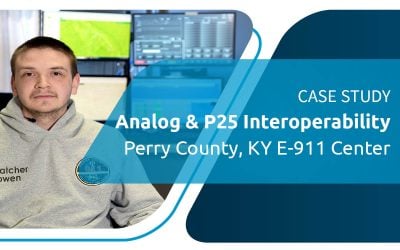
CASE STUDY | omnicore Dispatch with Analog Integration into Statewide P25 Network